What Angle Does a Circular Saw Cut?
A circular saw cuts square at 0 degrees by default, and its tilting base bevels the blade to about 45 to 57 degrees depending on the model. A few saws go past 50 degrees, and the most common stop points are 22.5 and 45 degrees.
On this page (9 sections)
- What angle does a circular saw cut in its normal position?
- How far can a circular saw bevel?
- What do the 22.5 and 45 degree stops mean?
- How do you set the bevel angle on a circular saw?
- What cuts does each angle make?
- Which circular saws reach which angles?
- How do you cut a bevel accurately on plywood and sheet goods?
- What mistakes throw off a bevel cut?
- Which angle should you set for your job?
A circular saw cuts square at 0 degrees when its base sits flat on the wood. The base also tilts, called a bevel, so the blade can cut at an angle from about 45 to 57 degrees on most models.
That range covers almost every angled cut in home carpentry.
The angle you set depends on the job. A square cut makes a board shorter or narrower.
A bevel cut changes the edge profile so two boards can meet at a corner. This guide covers what each angle means and how to set it.
What angle does a circular saw cut in its normal position?
A circular saw cuts at 0 degrees in its normal position, with the blade straight up and down and square to the base plate. The cut edge is 90 degrees to the face of the board.
At 0 degrees the shoe sits flat on the workpiece and the blade runs through the full depth of cut. The bevel pointer should line up with the 0 mark on the scale.
If it doesn't, the base is out of adjustment and the cut will lean slightly even though you asked for square.
Most saws also have a positive stop at 0 degrees. The stop is a small notch that clicks the base back into square, so you don't have to eyeball the scale.
Check it with a square when you first set up a new saw.
How far can a circular saw bevel?
The bevel range on a circular saw runs from 0 to about 45 to 57 degrees, and some models reach 50 to 51 degrees. The maximum is set by how far the base can tilt before it hits the motor housing or the blade guard.
- The DeWalt DWE575SB reaches 57 degrees, the widest range here.
- The Skil 5280-01 reaches 51 degrees with a positive stop at 45.
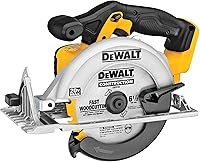
- The DeWalt DCS391B reaches 50 degrees.
The extra degrees past 45 are for steep chamfers and special joints. For everyday trim work and decking, the 45 stop is the one you'll use most.
A saw that only reaches 45 is still fine for standard corners.
Depth changes as you bevel. A saw with 2 9/16 in of depth at 0 degrees cuts less deep once the base tilts, so plan the angle before you set the blade depth.
Our guide to how deep can a circular saw cut covers depth in more detail.
What do the 22.5 and 45 degree stops mean?
The 22.5 and 45 degree stops mark the two angles you'll use most, and the stop notches click the base into place so it can't drift. A stop saves setup time when you cut the same angle over and over.
What is the 45 degree stop for?
The 45 degree stop is for miter joints and corner trim. Two boards beveled at 45 degrees meet to form a 90 degree corner, which is the standard outside corner on baseboard, casing and picture frames.
The 45 stop is also handy for chamfers on deck boards and fence rails. Set the base against the stop, tighten the lock and the angle stays put through a run of cuts.
The DWE575SB and the Skil 5280-01 both have this stop.
What is the 22.5 degree stop for?
The 22.5 degree stop is half of a 45 degree angle, used when you want a gentle chamfer or a 135 degree corner. It also appears in some roof and stair layouts where a 45 degree cut would be too steep.
Not every saw has a 22.5 stop. The DWE575SB includes one, while the Skil 5280-01 lists only the 45 stop.
If you cut 22.5 degree angles often, the positive stop makes repeat work quicker and more accurate.
How do you set the bevel angle on a circular saw?
Loosen the bevel lock, tilt the base to the mark you want, then tighten the lock and check the blade with a square before you cut. The steps are the same on corded and cordless saws.
- Unplug the saw or remove the battery.
- Loosen the bevel lock knob at the front or back of the base.
- Tilt the base until the pointer meets the angle on the scale or a positive stop.
- Tighten the lock firmly.
- Check the blade against a square or set the depth, then make a test cut.
The pointer and the scale can be a degree or so off, so a test cut in scrap is the best check. If the test edge isn't square when the pointer says 0, adjust the pointer or the stop screw.
Owners of the DWE575SB get a smooth aluminum base that holds its setting well.
What cuts does each angle make?
Each angle changes the shape of the edge, and the name of the cut tells you which face of the board you're shaping. The table below matches the angle to the job.
- 0 degrees: square cut. Shortens a board or rips it to width with a flat edge.
- 22.5 degrees: shallow chamfer or a 135 degree corner.
- 45 degrees: miter joint for corners and chamfers on trim.
- 50 to 57 degrees: steep chamfer or a special joint that needs more tilt.
A bevel cut shapes the edge face of the board. A miter cut shapes the end.
On a circular saw both are made by tilting the base, which is why the terms get used loosely. The bevel scale is what you set in both cases.
Which circular saws reach which angles?
The three saws here cover 50, 51 and 57 degrees, so the widest bevel range goes to the DeWalt DWE575SB. Pick by the range you need and whether you want a cord.
The DWE575SB is a corded 15 amp saw with a 57 degree bevel and stops at 45 and 22.5. It weighs 8.8 lb and cuts 2 9/16 in deep at 0 degrees.
That makes it the pick for trim work and steep chamfers where the full range matters.
The Skil 5280-01 is also corded, with a 15 amp motor and a 51 degree bevel plus a 45 stop. It weighs 8.7 lb.
Its single beam laser lines up the cut edge, which helps when you bevel and can't see the blade clearly.
The DeWalt DCS391B is cordless, runs on a 20V MAX battery sold separately, and bevels 0 to 50 degrees. Its magnesium shoe keeps it light and holds the base flat.
That suits jobs away from an outlet.
If woodworking is the main use and you want the best base and blade control, our guide to the best circular saw for woodworking compares the top options.
How do you cut a bevel accurately on plywood and sheet goods?
Mark the angle on the face, set the bevel, and guide the saw along a straight edge so the base can't wander. Sheet goods are thin and flexible, so support matters as much as the angle.
Set the blade depth so the teeth just clear the underside. Clamp a straight edge to the sheet at the line, then run the shoe against it.
On a bevel cut the blade exits at an angle, so the line you see on top isn't exactly where the edge lands.
A saw with a 50 degree or greater bevel covers most sheet goods work. For the full method, see how to cut plywood with a circular saw.
If the piece is thick, read can a circular saw cut a 4x4 before you try a deep bevel.
What mistakes throw off a bevel cut?
The base moving under the lock and a blade that isn't square are the two mistakes that spoil most angled cuts. Both are easy to catch with a test cut.
A dull blade bends as it tilts, so the cut edge wanders. A loose bevel lock lets the base creep halfway through a long cut.
Sawdust packed against the base also holds the shoe off the work and changes the angle without you noticing.
The saw's dust blower helps here. The DWE575SB, the Skil 5280-01 and the DCS391B each list a blower or dust feature that keeps the line of cut clear.
Clear the base and the scale after each session, and recheck the bevel lock before a run of cuts.
Which angle should you set for your job?
Set 0 degrees for square cuts, 45 degrees for corner joints, and 50 to 57 degrees only when a steeper chamfer needs it. The angle that matters most is the one the joint calls for.
For trim, decking and general framing, the 45 degree stop does most of the work. The DeWalt DWE575SB's 57 degree bevel and its 22.5 stop give the most flexibility for steep and half-angle cuts.
The Skil 5280-01 is the choice when you want a laser line at the 51 degree mark. The DCS391B suits cordless work at up to 50 degrees.
Whichever you pick, check the scale against a square and make a test cut before you trust the pointer. That one habit keeps what angle does a circular saw cut set at from drifting from what you actually get.
Frequently asked questions
What is the most common bevel stop on a circular saw?
The 45 degree stop is the most common, because a 45 degree bevel cut creates a miter joint when two boards meet at a corner. Many saws also have a 22.5 degree stop for half that angle, and some add a 0 degree stop so you can return to square quickly.
Does a 45 degree bevel cut make a miter joint?
Yes. A 45 degree bevel on one board and a matching 45 degree bevel on the board it meets form a 90 degree corner.
Bevels cut the edge face of the board, so the two tilted edges close together into the corner rather than meeting flat.
Can a circular saw cut past 45 degrees?
Many do. The DeWalt DWE575SB reaches 57 degrees, the Skil 5280-01 reaches 51 degrees and the DeWalt DCS391B reaches 50 degrees.
Those extra degrees let you bevel past the common 45 stop for steep chamfers and special joints.