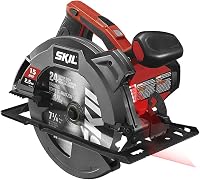
How Much Does a Circular Saw Weigh?
Most circular saws weigh between 7 and 12 pounds. A typical 7-1/4 inch corded model lands near 9 to 11.5 lb, and a 6-1/2 inch cordless saw is often around 7 lb before the battery goes on.
On this page (8 sections)
- How much does a circular saw weigh by type?
- How much does a cordless circular saw weigh with the battery?
- How much does a corded circular saw weigh?
- Why does blade size change how much a circular saw weighs?
- Is a heavier circular saw better?
- How does weight affect control and safety?
- How do you compare saw weights before buying?
- So how much does a circular saw weigh, and which should you buy?
A circular saw's weight usually falls between 7 and 12 pounds, with most 7-1/4 inch corded models landing near 9 to 11.5 lb. Cordless 6-1/2 inch saws often land around 7 lb as a bare tool, so the battery you attach changes the final number.
That range matters more than one figure. Blade size, motor type and power source all push the number up or down.
Here's how to read a circular saw's weight before you buy.
How much does a circular saw weigh by type?
Blade size and power source set the weight. A 6-1/2 inch cordless saw is the lightest common option, a 7-1/4 inch corded sidewinder sits in the middle, and a worm drive saw is usually the heaviest.
The DeWalt DCS391B is a 6-1/2 inch cordless model that weighs 3.16 kg, or about 7 lb without a battery. The DeWalt DWE575 is a 7-1/4 inch corded saw that DeWalt calls one of the lightest in its class at 8.8 lb.
The Skilsaw SPT77WML-01 worm drive weighs 11.5 lb and Skilsaw calls it the lightest worm drive on the market.
Worm drive saws carry extra weight because the motor sits behind the blade and drives through a gear set. That gearing gives more torque for thick lumber, and the trade-off is a heavier tool in your hands.
How much does a cordless circular saw weigh with the battery?
Add roughly 1 to 2 pounds to a cordless saw's bare weight once you fit the battery. A 20V pack is smaller than a 60V pack, so the same saw can weigh different amounts depending on which battery you own.
The DeWalt DCS391B is sold as a bare tool, with the battery and charger sold separately. Its 3.16 kg figure is the saw alone.
Attach a compact 20V pack and you're carrying closer to 8 lb, near a light corded saw.
Check whether the number you're reading includes a battery, then add your own pack for a fair comparison. For help matching a saw to the way you cut, see our guide to what a circular saw is used for.
How much does a corded circular saw weigh?
Corded 7-1/4 inch saws usually weigh 8 to 12 pounds, and the motor and base make up most of that. The DeWalt DWE575 sits at 8.8 lb, light for a 15 amp saw with a 7-1/4 inch blade.
Corded saws don't need a battery, so the whole tool weight is the weight in your hand. That makes them predictable.
The trade-off is the cord, which adds bulk when you carry the saw up a ladder or across a job site. Many buyers accept that for the consistent power a cord delivers.
If budget is part of the decision, our post on how much a circular saw costs covers the price tiers by type.
Who should pick the DeWalt DCS391B?
Pick the DCS391B if you want the lightest option here for one-handed work and overhead cuts. It's a 6-1/2 inch saw with a 5,150 rpm motor and a magnesium shoe, and it weighs about 7 lb before the battery.
The magnesium shoe keeps the base strong without adding much weight, and the rubber over-molded grip helps you keep control when the saw is light enough to move quickly. A 0 to 50 degree bevel covers angled cuts for trim and framing.
Skip it if you mostly cut thick stock on a bench and want a saw that sits heavy in the hand. Also remember to budget for a battery and charger.
Readers who want the full set of woodworking picks can compare them in our circular saws for woodworking guide.
Why does blade size change how much a circular saw weighs?
A bigger blade needs a bigger motor, a longer shoe and a heavier guard, so weight climbs with blade size. A 6-1/2 inch saw needs less of all three than a 7-1/4 inch model.
The blade itself is light, but the parts around it are not. A 7-1/4 inch saw carries a larger motor and a longer base.
A worm drive adds a gear housing behind the blade, which is another chunk of metal.
That's why a compact 6-1/2 inch cordless saw can undercut a full-size corded model on weight. If you mostly cut 2x lumber and sheet goods, the smaller blade handles most of the work and saves your arm.
If you rip thick hardwood, the larger blade and stronger motor usually earn their extra pounds.
Is a heavier circular saw better?
Not always. Weight helps in some cuts and hurts in others.
A heavier saw tracks straighter through long rips and resists kickback, while a lighter saw is easier to control overhead and for repeated cuts.
The DWE575's 8.8 lb and the SPT77WML-01's 11.5 lb both put mass behind the cut. On a bench with the wood supported, that weight keeps the shoe flat and the blade steady.
The Skilsaw's extra pounds come with 15 amps of power for ripping more lumber in less time.
Light saws win when the tool moves more than the wood. Trimming rafters overhead or cutting out window openings is easier with a saw near 7 lb.
Pick by how you cut: if the wood carries the saw, heavier is fine; if you carry the saw, lighter wins.
Who should pick the Skilsaw SPT77WML-01?
Choose the SPT77WML-01 if you want worm drive torque for thick lumber and long rips. It's a 15 amp, 7-1/4 inch saw with a magnesium housing, and it weighs 11.5 lb.
The worm drive gearing sends more power to the blade, which suits repeated cuts through 2x material and framing lumber. The 53 degree bevel covers steeper angles than the DeWalt cordless saw's 50 degrees.
Skilsaw includes a 24-tooth carbide blade and a multi-function wrench in the box.
Skip it if you work overhead or carry the saw up ladders all day. At 11.5 lb it's the heaviest saw here.
It's also corded, so you'll want an outlet or an extension cord within reach.
How does weight affect control and safety?
A saw you can hold steady is safer than one that pulls your arm down. Excess weight tires your grip, and a tired grip is slower to react if the blade binds.
Balance matters as much as total weight. The DCS391B's rubber over-molded grip and magnesium shoe are built to keep the saw balanced in one hand.
A nose-heavy saw tips into the cut and makes it harder to follow a line.
Kickback is the bigger concern. A heavier saw can push back harder when the blade binds, so keep the wood supported and stand to the side of the blade.
Always let the lower guard close and wait for the blade to stop before setting the saw down. The DWE575's anti-snag ball bearing lower guard is built to move smoothly through small cut-off pieces.
For a broader look at saw choices for home projects, see our DIY circular saw picks.
Who should pick the DeWalt DWE575?
Go with the DWE575 if you want a light corded saw for bench work and general cutting. It's a 15 amp, 7-1/4 inch saw that weighs 8.8 lb, which DeWalt calls one of the lightest in its class.
The 2-9/16 inch depth of cut handles thicker stock than a 6-1/2 inch saw. The 53 degree bevel with stops at 45 and 22.5 degrees covers common angles without hunting for the setting.
A dust blower keeps the cut line visible and on-board wrench storage keeps the blade change tool with the saw.
Skip it if you need cordless freedom or the extra torque of a worm drive. It's corded, so you'll manage a cord across the work.
The weight is friendly, but the power ceiling is lower than the Skilsaw's.
How do you compare saw weights before buying?
Check three things: the stated weight, whether it includes a battery, and what blade size the saw runs.
First, look for "item weight" in the specs. The DCS391B lists 3.16 kg, the DWE575 lists 8.8 lb, and the SPT77WML-01 lists 11.5 lb.
Those are the figures to compare. Second, ask whether the figure is bare tool or with a battery; cordless saws are often weighed without one, so add your pack's weight.
Third, match the saw's weight to your work. A saw within a pound or two of another will feel similar; the bigger gaps, like 7 lb versus 11.5 lb, are what you notice.
So how much does a circular saw weigh, and which should you buy?
Expect 7 to 12 pounds, and let your cutting style pick the number. For most people doing general cutting and woodworking, the DeWalt DCS391B is the easy pick at about 7 lb bare, with a 6-1/2 inch blade and a 5,150 rpm motor.
Choose the Skilsaw SPT77WML-01 when you need worm drive torque for thick lumber and don't mind 11.5 lb. Choose the DeWalt DWE575 for a light corded saw with a 15 amp motor and a 2-9/16 inch depth of cut.
If the numbers still feel close, our circular saw cost guide helps you weigh price against type before you decide.
Frequently asked questions
Does a circular saw's weight include the battery?
No. Cordless saws are usually listed as bare-tool weight, so you add the battery yourself.
A compact 20V pack adds around a pound or more, which pushes a lightweight cordless saw close to a small corded model.
How much does a worm drive circular saw weigh?
Worm drive saws are usually heavier than sidewinder models. The Skilsaw SPT77WML-01 weighs 11.5 pounds, which is on the light end for a worm drive but still heavier than most 6-1/2 inch cordless saws.
Can one person lift a circular saw all day?
Yes for most people, but a 12-pound saw held overhead or at arm's length tires the wrist and shoulder quickly. A lighter saw under 9 pounds is easier to control for repeated cuts, while a heavier model suits bench work where the wood carries the tool's weight.