How Deep Can a Circular Saw Cut?
A circular saw's cutting depth depends on its blade size and angle. A 7-1/4 in saw in this guide cuts up to 2-9/16 in at 90°, while beveling reduces its maximum depth.
On this page (7 sections)
- How deep can a circular saw cut at 90°?
- How does bevel angle change cutting depth?
- What affects a circular saw's cutting depth?
- How do you set cutting depth safely?
- Can one circular saw cut through thick wood in one pass?
- What should you check before choosing a saw for depth?
- How deep can a circular saw cut for your project?
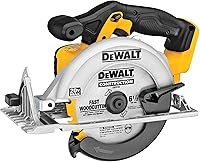
A circular saw's cutting depth depends on blade size and angle. The DeWalt DCS590B, a 7-1/4 in saw, cuts up to 2-9/16 in at 90° and 2 in at 45°.
Those numbers are model-specific. A larger blade can reach deeper than a smaller one, and tilting the blade for a bevel reduces its reach.
How deep can a circular saw cut at 90°?
At 90°, a saw reaches its greatest cutting depth. The exact maximum varies by model, so use the number in its manual instead of assuming that every saw with the same blade size cuts equally deep.
For a specific example, the DeWalt DCS590B has a stated maximum depth of 2-9/16 in at 90°. The DeWalt DCS565B has a 2-1/8 in maximum depth at 90°.
If you need to choose a blade size before buying, see what size circular saw you need. The best fit depends on the material you cut and how much depth the job needs.
How does bevel angle change cutting depth?
A bevel makes a shallower cut than a straight 90° cut because the blade meets the workpiece at an angle. The saw's depth adjustment can still be set, but the blade's reach through the material changes with the angle.
The DCS590B's maximum depth is 2 in at 45°, compared with 2-9/16 in at 90°. Other saws have different depth limits and bevel ranges, so check both values in the manual before cutting.
For an angled cut, mark the line and set the bevel and depth while the saw is unplugged or its battery is removed. Check that the shoe remains flat on the workpiece and that the blade can clear the support below it.
What affects a circular saw's cutting depth?
Blade diameter and cut angle are the main factors, while the saw's adjustment range determines how much of the blade can extend below its shoe. A sharp, suitable blade also matters for making a clean cut, but it doesn't increase the saw's rated depth.
The blade's size alone doesn't tell you the exact maximum. Compare the depth specifications at 90° and at the bevel angle you plan to use.
Do larger blades always cut deeper?
A larger blade can generally reach farther than a smaller blade, but the saw's design and adjustment limits matter too. Compare the actual depth figures rather than relying on the blade diameter as a guarantee.
For example, the Skilsaw SPT70WM-01 has a 10-1/4 in blade and is described as cutting 4x material in one pass. Its 51° bevel capacity is a separate feature from its straight-cut depth.
The Skilsaw SPT78W-01 has an 8-1/4 in blade and a 60° bevel capacity. That bevel range does not state its maximum cutting depth, so check its manual for the depth at your chosen angle.
If you need to cut a post, see whether a circular saw can cut a 4x4. That guide focuses on the workpiece and cut approach, while the saw manual remains the source for exact depth limits.
Does blade exposure affect cut depth?
Yes. Raising or lowering the saw's base changes how far the blade extends below the shoe, up to the limit built into that saw.
Set the depth for the material and follow the manual's adjustment instructions.
Use the saw's depth scale as a starting point, then check the blade's position against the workpiece. Keep the saw off while adjusting it, and verify that the blade won't contact a bench, sawhorse, or other support.
How do you set cutting depth safely?
Set the blade for the material thickness, then check the saw and workpiece before turning it on. Follow the manual because adjustment controls and recommended blade exposure differ among models.
- Unplug the corded saw or remove its battery.
- Set the workpiece on stable supports, with the cut path clear below.
- Loosen the depth adjustment and move the shoe to the desired setting.
- Check the blade's extension and tighten the adjustment.
- Confirm the shoe sits flat, then make the cut while keeping hands clear.
Don't hold a small piece by hand while cutting. Use supports that keep the offcut from pinching the blade, and keep the power cord or battery clear of the cut path.
For a first cut, review how to use a circular saw for beginners. If the workpiece is thicker than the saw's rated depth, don't force the saw through it or assume a second cut will line up safely.
Can one circular saw cut through thick wood in one pass?
Only if the saw's maximum depth at the chosen angle exceeds the material's thickness. Measure the workpiece and check the saw's manual before deciding whether one pass is possible.
A 4x post is often close to or beyond the reach of common saws, depending on the model and the post's actual size. Some larger saws are designed for a one-pass cut, while smaller saws may require a different tool or method.
Don't rotate the workpiece mid-cut unless you can keep it stable and accurately align both cuts. A blade that exits one side before you finish can leave a step or an uneven face.
If you're cutting sheet goods, read how to cut plywood with a circular saw. A guide and proper support help keep a long cut controlled, though they don't change the saw's maximum depth.
What should you check before choosing a saw for depth?
Compare the 90° depth, bevel depth, and material thickness for the jobs you expect to do. A saw with more reach can handle thicker stock, but it may be larger or heavier than you need for routine sheet cuts.
A 6-1/2 in saw may be enough for thinner boards and sheet goods if its stated depth covers the work. A larger saw can make sense for deeper cuts, but confirm the model's numbers and handling requirements before buying.
Use a straight 90° cut when the job calls for maximum depth. If you need a bevel, use the depth at that exact angle as your limit.
How deep can a circular saw cut for your project?
For a circular saw cut, match the saw's rated depth to the material thickness and angle. Use the manual's 90° figure for straight cuts and its bevel figure for angled ones.
Choose a smaller saw if its depth covers your regular work and its size suits the task. Consider a larger model for thicker stock, and read how to cut a 4x4 with a circular saw before attempting that cut.
Frequently asked questions
How deep can a 7-1/4 inch circular saw cut?
The DeWalt DCS590B has a maximum depth of 2-9/16 in at 90° and 2 in at 45°. Those figures are for that saw, not every 7-1/4 in model, so check the manual for your saw's depth at the angle you plan to use.
Can a circular saw cut all the way through a 4x4?
It depends on the saw's maximum depth and the wood's actual thickness. A standard cut may not pass through in one go, while a larger saw may be designed for that job.
Check the saw's manual, measure the stock, and consider whether a different tool is more suitable.
Does a bevel cut reduce circular saw depth?
Yes. Tilting the blade for a bevel reduces the depth it reaches into the workpiece compared with a straight 90° cut.
Use the depth chart or manual for your specific saw and bevel angle, then make a test cut in scrap if the setup allows.
How should I set circular saw cutting depth?
Set the blade so its teeth extend only enough below the workpiece for the cut, following the saw manual. Unplug a corded saw or remove its battery before adjusting it.
Check that the shoe sits flat and the blade clears the support underneath.