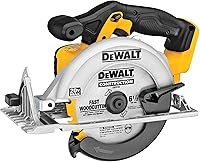
Which DeWalt Circular Saw Should You Buy?
Buy the DeWalt DCS590B 20V MAX XR if you want the most powerful cordless saw here. Pick the DCS391B for lighter framing and the DWE575SB 15 amp corded saw when you work near an outlet all day.
On this page (10 sections)
- Pick by power source: cordless or corded?
- Should you choose the 6-1/2 in or 7-1/4 in blade?
- Is the brushless DCS590B worth the step up?
- Is the lighter DCS391B the smarter buy for you?
- Where does the corded DWE575SB fit best?
- How much power and speed do your cuts need?
- Which blade and bevel settings come with each saw?
- What about batteries, weight and run time?
- When should you spend more on the brushless saw?
- So which DeWalt circular saw should you buy?
You have three main paths when deciding which DeWalt circular saw to buy: a light 6-1/2 in cordless saw, a more powerful 7-1/4 in brushless cordless, or a 15 amp corded model. The DCS590B 20V MAX XR is the best pick for most buyers, because its brushless motor and bigger blade do deeper cuts.
The DCS391B suits lighter work, and the DWE575SB corded saw gives steady power near an outlet.
DeWalt's saw range splits by power source, then by blade size and motor type. That is why "which DeWalt circular saw to buy" is really a question about your cuts and where you make them.
Read on for a plain breakdown of each saw, who it suits, and the blade and setup choices that follow.
Pick by power source: cordless or corded?
Choose corded if your cuts happen in one shop spot; choose cordless if you move around. That is the first fork in the DeWalt range, and it decides which family of saws you shop.
The corded DWE575SB draws on a 15 amp motor and never asks for a battery. Its speed is 5,200 rpm, and the saw weighs 8.8 lb, which DeWalt calls among the lightest in its class.
The two cordless models run on 20V MAX batteries. The DCS391B hits 5,150 rpm with a 6-1/2 in blade, and the DCS590B reaches 5,500 rpm (no-load) with a 7-1/4 in blade.
Neither includes a battery in the box.
A cordless saw frees you from a cord on ladders, fences and remote decks. A corded saw stays lighter in the hand than a battery saw plus a big pack, and it runs as long as the outlet works.
One more corded trait is worth knowing before you choose. The DWE575SB uses a patented Tough cord protection system, described by DeWalt as giving three times the durability against cord pull-out.
If you drag a saw around a bench or over sawhorses all day, that detail matters more than a spec-sheet number.
Who each power source fits
Pick corded if your workbench sits next to a socket, if you cut all day in the same bay, or if you dislike battery management. The DWE575SB is built for that shop routine.
Pick cordless if your cuts follow the job: a stairwell, a fence line, a neighbor's deck. A battery saw also packs away smaller for a truck or van.
If you are new to the tool, our explainer on what a circular saw is used for covers the core tasks before you choose a power source.
Settle the power source first, then compare motors and blades.
Should you choose the 6-1/2 in or 7-1/4 in blade?
A 7-1/4 in blade cuts deeper and a 6-1/2 in blade stays lighter. The blade size sets your maximum cut depth, which is the number that decides many framing jobs.
The DCS590B reaches a maximum depth of cut of 2-9/16 in at 90° and 2 in at 45°. Its blade sits on the right of the motor, a layout DeWalt calls out for ease of use on tough sites.
The DCS391B carries a 6-1/2 in blade, a size built for plywood, trim and standard 2x lumber. Its lighter build keeps it handy overhead and in tight spots.
The DWE575SB matches the bigger blade class with a 2-9/16 in depth of cut. That is the same 90° figure as the DCS590B, even though it is corded.
Depth of cut in practice
Depth matters when you cut thick doors, stacked sheets or posts. It also matters when you bevel, because a tilted saw loses depth fast.
The DCS590B spells that loss out in its own numbers: 2-9/16 in at 90° falls to 2 in at 45°. That 9/16 in gap is what a beveled cut costs you, and it is why a framing crew that tilts the shoe often steps up to the 7-1/4 in class.
If your work stays under a 6-1/2 in blade's reach, the smaller saw saves weight. If you regularly cut thicker stock, the 7-1/4 in models give you the headroom.
Set the blade size to your thickest regular cut, not your rarest one.
Is the brushless DCS590B worth the step up?
Yes, for buyers who cut hard or long. The DCS590B is the most powerful 20V MAX circular saw in this group, and its motor design sets it apart.
DeWalt lists it at up to 1,700 MWO and up to 368 cuts per charge on a 20V MAX battery. Its brushless motor returns 5,500 rpm no-load.
The saw adds an electronic brake that stops the blade from coasting after you release the trigger. It bevels to 57° with stops at 45° and 22.5°.
Its weight runs to about 9.88 lb, heavier than the 6-1/2 in DCS391B. That weight comes with more cut depth and more power.
Where the brushless motor pays off
Brushless motors run cooler and use less energy, so a single pack stretches across more cuts. That matters on a deck build or a day of trim work with one charger.
The brake helps most when you are cutting in tight spots or making repeated short cuts. It shortens the wait before you move the saw.
The layout earns its keep on demanding sites too. DeWalt orients the blade to the right of the motor and sets the handle on top, a design meant to keep the cut line easy to follow when you work overhead or reach across a sheet.
The 57° bevel range also clears steeper angles than the smaller saw's 50°.
Choose the DCS590B if power and cut depth lead your list. It is the saw I would pick for a framing-heavy job.
Is the lighter DCS391B the smarter buy for you?
The DCS391B suits buyers who value a light saw over maximum power. It covers most home projects without the extra bulk of the bigger 7-1/4 in model.
Its 5,150 rpm motor and 6-1/2 in blade handle framing lumber, plywood, shelves and trim. The magnesium shoe is high strength and lightweight, and the rubber over-molded grip adds balance.
The saw bevels from 0 to 50°, enough for most angled cuts. A keyless blade change makes swaps simpler, and the weight sits at about 3.16 kg.
Its lighter body makes overhead work less tiring. For a homeowner with a mixed project list, that is a real advantage.
The rubber over-molded grip is the other comfort point: it is there to give balance and control, so a smaller saw does not feel twitchy in one hand.
When the compact size wins
Short decks, garden structures, built-in shelves and rental-unit repairs fit this saw well. It also packs into a small vehicle or a crowded shop.
If you mostly cut sheet goods and standard studs, the 6-1/2 in blade rarely limits you. You save weight and cost by skipping the bigger saw.
Place the two against each other and the trade is clear: lighter body for everyday tasks, or bigger blade for deeper cuts.
Where does the corded DWE575SB fit best?
The DWE575SB fits a fixed workshop or a power-hungry crew. Its 15 amp motor delivers consistent power without battery swaps, and at 8.8 lb it stays light in the hand.
DeWalt fits a patented 15 amp motor and an electric brake that stops the blade on trigger release. The bevel range runs to 57° with stops at 45° and 22.5°, and the depth of cut is 2-9/16 in.
The aluminum base stays smooth for accurate cuts across many jobs. A ball bearing lower guard is built for long life in harsh settings, and the lower guard design helps on bevel cuts and shims.
An integrated dust blower clears your line of sight as you cut. The Tough cord protection system adds durability against cord pull-out.
The corded advantage
If your saw lives on a bench with a socket nearby, a cord is no burden. You get steady power and no pack to charge, which suits repetitive production cuts.
The model ships with a blade wrench, a carbide-tipped 7-1/4 in blade, a manual and a contractor bag. That is a ready-to-work kit beyond the bare tool.
The 15-tooth blade in the kit is a framing-style tooth count, so the saw arrives set up for fast rough cuts rather than finish work.
For a shop-based furniture builder, this saw may beat both cordless options. It is the pick when the outlet is always within reach.
The integrated dust blower is a small but useful extra in a closed shop, since it clears the line of sight without a separate vacuum hookup.
If your projects lean toward finer woodworking, our roundup of circular saws for woodworking compares more options.
How much power and speed do your cuts need?
Match motor power to the material, not to a spec sheet. A bigger motor and higher rpm help on dense or thick stock; light trim work rarely needs either.
The three saws rank by speed and motor type. The DCS590B leads at 5,500 rpm no-load with a brushless motor rated up to 1,700 MWO.
The DCS391B runs at 5,150 rpm. The DWE575SB holds 5,200 rpm on 15 amps of corded power.
The gap between 5,150 and 5,500 rpm looks small on paper. What separates them is the motor type behind the number: the brushless DCS590B pairs its speed with a motor rated in maximum watts out, a measure of usable muscle rather than raw spin.
The corded saw skips that rating and leans on 15 amps of wall power instead.
In practice, the DCS590B has the most torque for tough rips. The corded saw offers steady 15 amp power with no battery sag.
The DCS391B covers a mixed list of home cuts.
A sharp blade matters as much as the motor. A dull blade on a strong saw burns and binds, while a fresh blade on a smaller saw cuts clean.
Pick the motor that clears your hardest regular cut, then keep good blades on it.
Which blade and bevel settings come with each saw?
The saws share bevel basics but differ in maximum angle. All three bevel, and each covers common angles for framing and trim.
The DCS391B bevels 0 to 50°. The DCS590B and DWE575SB reach 57° with stops at 45° and 22.5° for repeatable common angles.
Blade size differs too. The DCS391B uses a 6-1/2 in blade, while the other two use a 7-1/4 in blade.
DeWalt ships the DWE575SB with a 15-tooth carbide-tipped blade. The DCS391B's 6-1/2 in blade is listed with 18 teeth, a tooth count between a fast framing blade and a cleaner trim blade.
A keyless blade change on the DCS391B and an electric brake on the DCS590B and DWE575SB round out the differences.
Matching blades to the saw
Buy blades that fit your saw's arbor and diameter, and choose tooth count for the work. Fewer teeth cut fast in framing; more teeth leave cleaner edges in trim and plywood.
A general-purpose combination blade covers mixed shop work. Keep a framing blade on hand for rough lumber and a fine-tooth blade for finish cuts.
Set bevels and blades to the task, then let the motor work. Light pressure cuts cleaner than force.
Blade choice changes as much as the saw itself; see our guide to best circular saws for DIY for picks by project type.
What about batteries, weight and run time?
Battery platform is the hidden cost of a cordless saw. Both cordless DeWalt models are bare tools, so you need 20V MAX packs and a charger.
If you already own 20V MAX drills or drivers, you can share packs. The DCS590B stretches a pack with its brushless motor and up to 368 cuts per charge.
The DCS391B uses packs too, without the brushless efficiency.
Weight differs by design. The DCS391B runs about 3.16 kg, and the DCS590B is about 9.88 lb.
The corded DWE575SB sits at 8.8 lb with no pack to add. The DCS590B's dimensions are 15.35 x 9.44 x 9.6 inches, while the DCS391B measures 15.5 x 8.5 x 10.5 inches, so the two cordless saws take up similar space on a shelf.
That means the two cordless saws and the corded one land in a similar weight zone once a battery is on. A big pack or a small one shifts the balance.
Both cordless models list one lithium-ion battery as required, a reminder that the pack is part of the purchase even when it is not in the box.
Buy for the batteries you own, or budget for packs and a charger. On cordless jobs, pack count decides your day.
When should you spend more on the brushless saw?
Spend up when your work is hard and frequent. The DCS590B earns its higher position when you frame, cut dense lumber and make long runs of cuts.
Its brushless motor, 1,700 MWO rating and 2-9/16 in depth at 90° handle heavier work. The electronic brake and 57° bevel add control on angled jobs.
If your projects are occasional and light, the DCS391B saves weight and cost. If your work is shop-based, the corded DWE575SB gives steady power without chargers.
The brake on the DCS590B also shortens the wait between repeated short cuts, which adds up when you are cutting blocking or studs to length all afternoon.
Decide using job type, not brand loyalty. DeWalt's line spans these three roles, and each saw fits one.
The 6-1/2 in saw leans toward trim and sheet goods, the 7-1/4 in brushless toward framing and heavy stock, and the corded model toward the bench.
Pay for more power only if your cuts demand it. A light saw that fits your work beats a heavy one that does not.
For a wider brand view, our DeWalt vs Milwaukee circular saw comparison breaks down the two lines.
So which DeWalt circular saw should you buy?
For most buyers, the DCS590B 20V MAX XR is the answer to which DeWalt circular saw to buy. It pairs the most power in this group with a 7-1/4 in blade, deep cuts and an electric brake.
The rules are simple. Pick the DCS590B for heavy cordless work and deeper cuts.
Pick the DCS391B for lighter home and DIY projects where weight matters. Pick the DWE575SB for shop work near an outlet and steady 15 amp power.
Then match a blade to the job and check the battery platform if you go cordless. Get the saw that fits your cuts.
Frequently asked questions
Which DeWalt circular saw should I buy first?
The DCS590B is the best first pick for most buyers who want cordless freedom, because its brushless motor and 7-1/4 in blade cover deeper cuts. Choose the corded DWE575SB if you mostly work near an outlet and want steady power.
Is a 6-1/2 in or 7-1/4 in circular saw better for woodworking?
A 7-1/4 in saw cuts deeper, so it handles thicker lumber and stacked materials. A 6-1/2 in saw is lighter and cheaper to run, which suits plywood, trim and framing from a smaller platform.
Match the blade size to your thickest regular cut.
Do I need a cordless circular saw or a corded one?
Go cordless when you cut away from outlets, on ladders or around a job site. Go corded when you work in one shop spot and want 15 amps of power without battery cost.
Both saws here cut wood well; the setting decides it.
Does the DeWalt DCS590B include a battery?
No. The DCS590B ships as a bare tool, so you need a 20V MAX battery and charger.
The same applies to the DCS391B.
If you already own DeWalt 20V tools, you can share packs across them.
What can a 6-1/2 in circular saw cut?
A 6-1/2 in saw handles standard 2x framing lumber in one pass and cuts plywood, trim, decking and shelving. Its smaller blade reaches less depth on thick stock, so check your thickest cut.
It stays lighter for overhead and one-hand work.
Which DeWalt circular saw is best for DIY projects?
The DCS391B is a strong DIY pick because it stays light (about 3.16 kg) and covers most home projects. If you want more power and deeper cuts, step up to the DCS590B.
Read more advice in our DIY saw guide.